Joe Wilkins
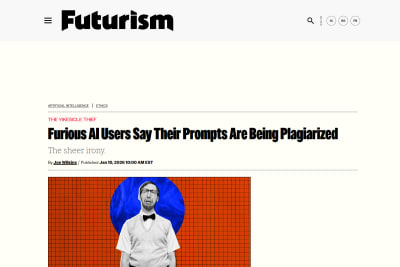
Furious AI Users Say Their Prompts Are Being Plagiarized
Some power users of generative AI have grown so comfortable with their new tools — especially image-generating ones — that they now feel entitled…
Hi, I'm Nicolas Hoizey.
I've been passionate about the Web since 1996. I also love photography (here's my photography portfolio), and have many other interests.

Joe Wilkins
Furious AI Users Say Their Prompts Are Being Plagiarized
Some power users of generative AI have grown so comfortable with their new tools — especially image-generating ones — that they now feel entitled…

Not All Browser APIs Are “Web” APIs
The web is a level playing field. The web is open. The web is for everyone. It's a nice idea. But with the above APIs, the web is not a level playing…

Idan Dardikman
8 Million Users' AI Conversations Sold for Profit by “Privacy” Extensions
Midway through the conversation, I paused. I realized how much I'd shared: not just this decision, but months of conversations-personal dilemmas,…
What Music Ownership Means to Me
Streaming as a way of playing music is fine. Streaming as a replacement for owning is what I don’t trust. At the end of the day it’s rented access,…

Based on conversations I've had with people who still maintain an active presence there (and I'm not counting journalists who don't post but read…
JAMstack is fast only if you make it so
JAMstack often promotes itself as an excellent way to provide performant sites. It's even the first listed benefit on jamstack.wtf, a "guide [which] gathers the concept of JAMstack in a straight-forward guide to encourage other developers to adopt the workflow". But too many JAMstack sites are very slow.
Can we monitor User Happiness on the Web with performance tools?
I really like that SpeedCurve tried to innovate with this recent "User Happiness " metric (original version ). It aggregates multiple technical metrics to decide if users visiting the page are happy or not with it. But I see several issues in this metric.
Evan Minto wrote a great article showing the Internet Archive has tested the actual root font-size set by their visitors, and the result shows a lot of people still change the default one: Pixels vs. Ems: Users DO Change Font Size.
These are the tags the most used on the site to set content topics:
Browse all tags…
 Kilian Valkhof
 fLaMEd
 Robin Berjon